chart

About Chris Hart

This author has not yet filled in any details.
So far Chris Hart has created 152 blog entries.

2021 Global Bird Rescue

By |2021-12-06T16:36:12-05:00December 6th, 2021|The Egret Article|

By Jennifer Nantais

The Global Bird Rescue is an annual week-long event where citizens search for birds that have collided with windows in urban areas. The goal is to find injured birds quickly to get them the help they need and increase their chances of survival, and record all collision incidents, casualties and survivors. The purpose is to identify the extent of the losses taking place in order to mitigate hazards and make communities safer.

Previous participation in the area was limited to a few entries submitted by Erie Wildlife Rescue in 2020, and this year the Bird Friendly Windsor team conducted the first volunteer outing in Windsor. While many individuals agreed to check around their home or workplace, a small group headed out to actively search for collision victims. The team consisted of PIBO Executive Director Suzanne Friemann, Urban Bird Educator Jennifer Nantais, and Essex County Field Naturalists club member Carl Maiolani, who of course took care of organizing the weather for the day.

The team gathered at City Hall just before sunrise, and when the three met in the still dark morning, Carl had already found the first bird of the day. The team walked around municipal buildings, several others in the downtown and Riverside area, and the University of Windsor campus, finding 10 birds during their morning effort.

While conducting the search, the team assessed the built environment, to see Windsor through the eyes of the many birds we share the city with. They soon began to recognize which sites present potential dangers, knowledge which as it continues to grow, will streamline future Global Bird Rescue events.


The hazard presented by habitat reflected in glass. Photo: Jennifer Nantais.

Migration is a dangerous time for birds. They travel long distances, expose themselves to potential predators, and need to be able to find necessary resources like food, water and shelter along the way. For many of these birds, this journey would be their first fall migration, and for too many, their last. Of the young born this past spring, many will never make it to their wintering grounds as the result of a hazard that can be prevented. This problem has a solution – windows can be adapted to prevent bird collisions. To solve this problem, it first has to be identified. Proving that certain areas present a danger can be done through demonstrating the sheer number and variety of birds that have died at a certain location.

Sad though it was to find beautiful birds dead at the base of expansive glass which reflects the habitat that they were striving to reach, with each bird recorded came a sense of purpose. Millions of birds lose their lives this way across the globe, but these birds at least, won’t be forgotten.

If you find a bird that has collided with a window, contact your local wildlife rehabilitation organization. If you find a bird that has died as a result of a window collision, make it count by uploading it on the Global Bird Collision Mapper, or sending a photo, date and location to

Wings Rehabilitation Centre (519) 736-8172

Erie Wildlife Rescue (519) 735-3919

Birdmapper.org

Comments Off on 2021 Global Bird Rescue

A New App for the Twitcher’s Toolkit

By |2021-12-05T22:58:16-05:00December 5th, 2021|The Egret Article|

By Laura Foy

If you’ve ever subscribed to a rare bird alert notification, you’ll be all too familiar with descriptions like this, “Travel west 2/3rd of the way down Army Camp Road from Hwy 21, look for orange flagging tape on the fence on your left. Look for hydro pole 2146.” It gets even worse if there’s no roads involved, “5 in weedy areas near flooded fields, 2 at least along trail behind pond (north side toward transmission tower).”

These descriptions are somehow overly wordy while at the same time being imprecise.

Enter what3words, a geocoding system that breaks the world down into 3 m squares and assigns each square a unique three-word address. For instance, the front door to the Ojibway Nature Centre is located at ///rattler.whistle.dust. The bird blind at Hillman Marsh is at ///chicken.garments.good. The Serengeti Tree at Point Pelee is at ///feasting.pitted.bypasses.

Screenshot of Google Maps focused on Ojibway Nature Centre

Land-based what3words addresses are available in more than 45 different languages. In English the algorithm uses 20,000 words in a pseudo-random distribution to try and avoid similar words and homophones from ending up too nearby to one another. Once an address is identified, the app will integrate with Google Maps or your chosen navigation system to provide turn-by-turn directions. For off-road locations, the app has a built-in compass mode. The app can even be used without an internet connection.

The UK-based company was initially launched in 2013 but has been gaining mainstream recognition in the last few years. More than 85% of emergency services in the UK now use what3words to help coordinate their responses for situations like wilderness rescues. Dozens of services across Canada have also adopted the system, including the Ontario Provincial Police. Mercedes-Benz, Ford, Triumph Motorcycles and Lamborghini have all integrated what3words into their navigation systems. The country of Mongolia has even adopted the system in place of postal addresses!

The system’s usefulness extends to conservation and citizen science applications. The Tees Rivers Trust accepts user reports of giant hogweed in the form of what3words addresses to target and control the invasive species. Endangered species can be similarly reported. Organizations can use it for volunteers to join a remote tree planting, find parking, locate a trailhead, designate accessible entrances, and pinpoint bathroom locations (particularly if they are temporary).

While it probably won’t supplant the more technical uses of GPS, it does make it far easier to communicate hard-to-describe locations. From now on, you’ll see me popping up in your rare bird alerts using what3words addresses.

The free app is available for iPhone and Android. For more information or to use the service via their website, visit https://what3words.com/.

Nelson’s sparrow with corresponding what3words location (Photo by Andrew Campbell)
Comments Off on A New App for the Twitcher’s Toolkit

The first annual Lynda Corkum ECFNC Bursary

By |2021-12-07T19:23:37-05:00December 5th, 2021|The Egret Article|

By Chris Hart

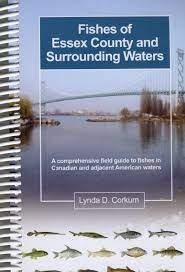
In the Club’s continuing effort to support the fascination and exploration of nature by our community, we are pleased to announce the contribution of a bursary to a graduate student in the Biology department at the University of Windsor. This bursary was made possible by funds collected through sales of the Fish Book (more formally, The Fishes of Essex County and Surrounding Waters), and as such, has been named after its author, Lynda Corkum.

The Club is pleased to announce the winner of the 2020/21 Lynda Corkum Essex County Field Naturalists’ Club bursary is Erika Nissen, a second year Master’s student working in Dr. Oliver Love’s research lab. Erika works on movement modelling data in Common Eider sea ducks in the Canadian Arctic. Erika expresses her deep gratitude towards to the club and says “the financial support has been a great help towards my educational expenses for the present school year and has been a great motivator in validating the importance of the research I am lucky enough to be conducting.”

Following the announcement of the award, Lynda herself reached out to congratulate Erika. In her letter, Lynda provided a detailed history of the Fish Book. Although much of the Club’s membership may be familiar with the Fish Book (and hopefully a proud owner), some might be unaware of how it came to be. In order to properly pass along its origin story (as well as that of the Bursary), please see the attached copy of Lynda’s letter below.

Dear Erika,

JoAnn Grondin sent me the correspondence between the two of you today, announcing that you were the recipient of the Lynda Corkum Essex County Nature Bursary Award. Congratulations, Erika. You are the first recipient of the award.

I thought you might like to know how funds were established for the award. In 2010, I wrote a field guide for the Essex County Field Naturalists’ Club. Tom Hurst, a former President of the club, asked me to write a field guide on fishes. The book is entitled, The Fishes of Essex County and Surrounding Waters. All proceeds (every dollar) from the sale of the field guide went to the club.

Once the book was published, several volunteers and friends helped to sell the book. I gave talks to many organizations in Ontario and in the United States. Friends, JoAnn Grondin, Linda Menard-Watt, Teresa Austrin and her husband, Joe Parent, and I went to county fairs, and countless fish shows. I gave talks to many nature clubs, a Rotary Club and anywhere where people were interested in learning about fish and fishing. Dave Kraus kindly stored the books in his garage. There were 3,000 copies of the book printed. Box by box, books were sold. Dave still has many boxes in his garage. I set the price for the book at $25 (Cdn or USD) so that a youngster might be able to afford to buy the book. Even if one doesn’t fish, the book is interesting to read because of the ecology and behaviour of fishes, and historical aspects of fishing in the region.

You will smile if you knew where my friends and I flogged the book. I sold two copies to my optometrist in Windsor and one to another patient who happened to be in the office at the time. I sold four copies of the book to my financial advisor! My friend Linda was wonderful at corralling people to buy the book. When Teresa, Joe and I crossed the border to Detroit for one of my book talks, we had an interesting chat with a Customs Official. Teresa, leaning forward from the back seat and handing a copy of the book to the official, tried to get the fellow to buy a copy of the book. No luck on that sale! Interestingly, I was contacted by a representative of the Emperor of Japan, who wished to buy a signed copy of the book. He had published articles on Gobiidae and so was interested in reading about Round Goby and Tubenose Goby in the Laurentian Great Lakes. The late, Dr. David Noakes, told me to send a copy of the book to Prince Charles, who is an avid angler. Although the Emperor of Japan bought the book, I gave a copy to Prince Charles. Interestingly, I received a thank you note from the Secretary of Prince Charles. Thanks to Dave Kraus, Graeme Gibson and Margaret Atwood received a signed copy of the book.

I received some lovely messages from people who bought the book. One woman bought the book for her husband. She wrote to me saying that her husband, who never reads, was enthralled with the book, calling out to her whenever he read neat tidbits of information.

After many books were sold, the Field Naturalists had to decide how the funds were going to be used. Jesse Gardner-Costa, former president of the club, was instrumental in planning for the disbursement of funds. Initially, we thought that awards would be given to students, who made contributions to Essex County. I had hoped that students from a high school, college or university would be eligible for the award. Eventually, we decided to give the award to a graduate student in Biology, Earth Science or Environmental Engineering. However, the club was told by the University of Windsor that it would be best if students in one department would be eligible for the award; Biology was selected.

Erika, thank you for your thoughtful email message to JoAnn on the receipt of the award. I am glad that the funds were able to help you with your educational expenses. I think you should get a copy of the book!

Good luck with your research endeavours. I hope you have a happy, productive life.

Sincerely,
Lynda Corkum

Comments Off on The first annual Lynda Corkum ECFNC Bursary
Go to Top