The Egret Article

Butterfly Committee Update: Meet the Members!

By |2026-09-09T02:59:28-04:00September 9th, 2026|The Egret Article|

By Jeremy Hatt

The Butterfly Committee recently had our second meeting to reflect on the Committee’s work in 2026 and brainstorm ideas for 2027.

Over the past year, the Committee brought three new Ontario Butterfly Monitoring Scheme (OBMS) routes to Essex County including at Ojibway Park, Little River Corridor, and Hillman Marsh. Two additional routes are planned for 2027 including Malden Park and a site in Kingsville. These weekly monitoring routes have provided invaluable data on the timing and abundance of butterflies in Essex County. We plan to summarize these findings in a future Egret article.

We also gave a presentation to the Club introducing the Butterfly Committee as well as an overview of the species that call our county home. As a result, the Greater Windsor Horticultural Society recently reached out and has requested the Committee provide a similar presentation to their group in the future with a focus on native gardening for butterflies.

During the presentation, we encouraged members to use iNaturalist and eButterfly to log their sightings in the county. To help with this, Olivia Galloway wrote an instructional piece on what eButterfly is and how to use it. The article can be found here: https://www.essexcountynature.com/what-is-ebutterfly-and-how-does-it-work/.

Finally, the Committee was heavily involved in helping with the Butterfly Counts that take place in Essex County including Pelee Island, Ojibway Park, and the newly-resurrected Point Pelee Count. A summary of these counts is included in this issue of The Egret.

Before the meeting, I asked each member of the Committee to name their favourite butterfly and why. Here are the results!

Summer Azures – Photo by Jeremy Hatt
Eastern Comma – photo by Corinne Allsop

<Jeremy Hatt (Chair) – “My favourite butterfly in Essex County is the Summer Azure. This familiar little white-and-light-blue butterfly is a welcome sight throughout the summer months. My favourite encounter w/ this species is seeing large groups mud-puddling together on the trails of Point Pelee; always a magical experience.” 

>Grace Tiessen – “My favourite butterfly in Essex County is the Eastern Comma. It’s usually one of the first butterflies I see each year, so it always gets me excited for spring! I also love the unique shape of their wings.”

Black Swallowtail caterpillar – photo by Kate Derbyshire
Bronze Copper – photo by Paula O’Rourke
Harvester – photo by Olivia Galloway

Marisa Pfautz – “My favorite butterfly of the year is the Black Swallowtail. We grew dill in our garden this year and were able to find and raise a few caterpillars into butterflies. It was fascinating to watch them go through several molt cycles, create their chrysalis, and emerge with the gorgeous colouring they are known for. We hope to see them in the garden again next year!”

Paula O’Rourke – “It is very difficult to pick a favourite! But as soon as I think of butterflies, the Bronze Copper pops into my mind. I rarely see them but whenever I do I feel extreme butterfly joy. They are so small, delicate and colourful. Never fails to make me smile.”

Olivia Galloway – “My favourite butterfly in Essex County is the Harvester, our only carnivorous species. Though typically rare, we’ve had some magical encounters with them this year!”

American Snout – photo by Cameron Chevalier
Common Buckeye – photo by Jacob Stasso

Cameron Chevalier – “My favourite butterfly in Essex County is the American Snout. What’s not to love about a butterfly that looks like a leaf and has a tiny elephant trunk? I love encountering them at Point Pelee, though it feels even more special when I see one outside the Park.”

Jacob Stasso – “Common Buckeye is the best butter – for its subtle plumage, elegant beauty, striking fur, and prominent eyes.”

Michelle Gordy: “I’ve been an ECFNC member for two years and joined the Butterfly Committee to learn something new and spend more time outdoors. Having recently volunteered for my first butterfly count at Point Pelee, I’m excited to now be able to identify a few species. Being a backyard gardener, I started planting some native flowers and just this year has noticed the butterfly diversity starting to grow beyond the common Cabbage White. This year, a pair of Monarchs have graced the yard all summer as well as a Giant Swallowtail and a pair of Peck’s Skippers. My current favourite butterfly is the Spicebush Swallowtail because I find them to be stunningly beautiful and I got to chase one down for the count at the marsh boardwalk this summer to finally see one up close. This species inspires me to want to add some spicebush to my garden in the coming years so that maybe I’ll get the chance to photograph one.

Spicebush Swallowtail – photo by Cameron Chevalier
Comments Off on Butterfly Committee Update: Meet the Members!

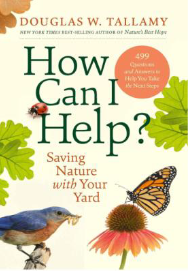
Every Yard Matters: A Book review of “How Can I Help? Saving Nature With Your Yard” by Douglas Tallamy

By |2026-09-09T02:31:50-04:00September 9th, 2026|The Egret Article|

By Lucy Diesbourg

Dr. Douglas Tallamy, is an entomologist, conservationist, and professor at the University of Delaware, who has written several books. I found “How Can I help” an easy to read yet informative book, aimed to help relay scientific concepts and research to the ‘average’ person. It explains things simply, but also with enough scientific research detail, to show just how native plants ultimately support our human race on this earth.

I had never really heard of the concept of the ‘food web’ before. What and why should I care about the food web? The food web is what transfers energy that plants harness from the sun to other organisms. This transfer of energy from plants, to plant eaters, to predators; across multiple trophic levels, is what enables all animal species to exist on earth. And that includes us human beings. Our garden ‘pests’, like mosquitoes and wasps, all have a place in this environmental food chain that is very important, and without them, the other things we love will not be able to continue on. I guess I had taken all this for granted.

The book also reinforced for me just how vital native plants and biodiversity are for our ecosystems and for our life on earth. Our flora and fauna co-evolved over millions of years. They need each other. Somehow, our concept of an average suburban garden has become grass and several non-native trees, bushes and flowers, or ornamentals. Dr Tallamy notes that having some non-natives plants in our yards is fine, but we should look at them more like adding a statue to our garden because that is about how much ecological value they provide.

The book is structured around 499 commonly asked questions on topics such as biodiversity, native plants, invasive species, pest control, restoration, and supporting wildlife. Some people may find the answers a bit repetitive, but I actually appreciated hearing things explained again from a different angle under the different topic headings. This reinforced the concepts for me as well as the importance of the author’s message.

The takeaways for me were, that every yard matters! Even small urban spaces can support wildlife and biodiversity. Planting native species supports insects, birds, and other wildlife, forming the foundation of healthy ecosystems. And we all have the power to make a difference in improving that ecosystem. 

Tallamy encourages everyone to join the Homegrown National Park initiative to get all citizens to transform their properties into wildlife-supporting habitats.  Protected areas like national parks and conservation areas are not enough. ‘Wild’ areas are shrinking fast and/or being invaded by non-native species. But everyone can be part of the solution to the biodiversity crisis. He states that, “If half of American lawns were replaced with native plants, we would create the equivalent of a 20-million-acre national park, nine times bigger than Yellowstone.”

After reading this book I felt empowered that I can help make a difference, and do that by making changes in my own yard. I have been reducing my lawn area, planting more native species, leaving leaves undisturbed, and thinking differently about pest control. All those little things we do, just planting one native plant, can make a difference. And it is crucial that we all do.

Book review submitted by Lucy Diesbourg on behalf of ECFNC Native Plant Committee

Comments Off on Every Yard Matters: A Book review of “How Can I Help? Saving Nature With Your Yard” by Douglas Tallamy

Building Community through Nature: ECFNC Supports Diversity Dignity Leamington BBQ at Seacliff Park

By |2026-09-09T02:27:54-04:00September 9th, 2026|The Egret Article|

By Jeremy Hatt

Early in 2026, ECFNC was honoured to receive a micro-grant of $2,600 on behalf of Point Pelee National Park through the Government of Canada’s Gender Based Analysis Plus (GBA+) program. The purpose of the grant is to support partners and stakeholders in developing and enhancing programs and products that are more inclusive, accessible, and effective for a wider range of people, ensuring fairness and equal opportunity for the people of Canada.

As outlined in the June issue of The Egret, ECFNC used part of this grant money to provide transportation via South Essex Community Council (SECC) to the Birding With Pride event at Point Pelee. This was coordinated with Diversity Dignity Leamington (DDL), a Spanish-speaking support group for the local 2SLGTQIA+ Community that provides a safe, welcoming environment to newcomers and residents to connect, receive support, and access essential resources in their native language.

ECFNC continues to build its relationship with DDL, providing funds to support the group participating in outdoor or nature-related events. On July 19, DDL held a BBQ at Seacliff Park, and ECFNC provided the necessary funds for the event. Over 20 people attended, providing a chance for newcomers to meet fellow members of the LGBTQ+ Community and share a fun, relaxing afternoon at the park. Hot dogs, hamburgers, snacks, drinks, and desserts were all provided.

Diversity Dignity Leamington attending the BBQ at Seacliff Park- photos by Jeremy Hatt

Attendees off the BBQ enjoying gorgeous weather and good food – photo by Liliana Salazar

ECFNC is proud to support groups like DDL who are making a significant difference in our local community. As a member of the Board of both ECFNC and DDL, I hope to continue to strengthen our relationship and support further events that are more inclusive and accessible.

After the Seacliff Park BBQ, ECFNC received the following letter on behalf of SECC and DDL. It is important that ECFNC continues to build relationships with other community groups in Essex County so we can all enjoy and appreciate the natural world.

“Dear Essex County Nature,

On behalf of the South Essex Community Council (SECC) and Diversity and Dignity Leamington (DDL LGBTQ+), we would like to express our sincere gratitude for your generous financial support.

DDL LGBTQ+ has grown from a small gathering of LGBTQ+ newcomers and refugees into a welcoming grassroots community that continues to grow and provide a safe, inclusive space for connection and belonging. SECC has been proud to support the group’s journey by providing guidance and resources, and it has been inspiring to see the community flourish.

 Your donation allowed us to invite members of the LGBTQ+ community and English language students from Leamington to participate in Essex County Nature’s annual birdwatching event at Point Pelee National Park. For many participants, it was their first time attending this wonderful event and a meaningful opportunity to connect with nature, make new friends, and feel welcomed as part of the broader community.

 We are also grateful for your support of our DDL LGBTQ BBQ at Seacliff Park. Your generosity helped create a safe and welcoming space where LGBTQ+ newcomers could come together, build friendships, and simply enjoy being themselves in an environment where they felt accepted and included.

We would also like to thank Jeremy for helping connect our organizations. His support has made it possible for more people to participate in these meaningful experiences and has strengthened the partnership between Essex County Nature and our community.

 Thank you once again for your generosity and your commitment to building a more welcoming and inclusive Essex County. We truly appreciate your partnership and look forward to working together again in the future.

With sincere gratitude,

 Liliana Salazar (SECC) and Rene Lemus Jimenez (DDL)”

Comments Off on Building Community through Nature: ECFNC Supports Diversity Dignity Leamington BBQ at Seacliff Park
Go to Top