
By Lucy Diesbourg
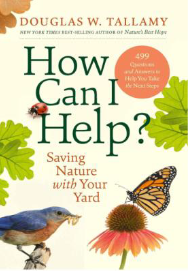
Dr. Douglas Tallamy, is an entomologist, conservationist, and professor at the University of Delaware, who has written several books. I found “How Can I help” an easy to read yet informative book, aimed to help relay scientific concepts and research to the ‘average’ person. It explains things simply, but also with enough scientific research detail, to show just how native plants ultimately support our human race on this earth.
I had never really heard of the concept of the ‘food web’ before. What and why should I care about the food web? The food web is what transfers energy that plants harness from the sun to other organisms. This transfer of energy from plants, to plant eaters, to predators; across multiple trophic levels, is what enables all animal species to exist on earth. And that includes us human beings. Our garden ‘pests’, like mosquitoes and wasps, all have a place in this environmental food chain that is very important, and without them, the other things we love will not be able to continue on. I guess I had taken all this for granted.
The book also reinforced for me just how vital native plants and biodiversity are for our ecosystems and for our life on earth. Our flora and fauna co-evolved over millions of years. They need each other. Somehow, our concept of an average suburban garden has become grass and several non-native trees, bushes and flowers, or ornamentals. Dr Tallamy notes that having some non-natives plants in our yards is fine, but we should look at them more like adding a statue to our garden because that is about how much ecological value they provide.
The book is structured around 499 commonly asked questions on topics such as biodiversity, native plants, invasive species, pest control, restoration, and supporting wildlife. Some people may find the answers a bit repetitive, but I actually appreciated hearing things explained again from a different angle under the different topic headings. This reinforced the concepts for me as well as the importance of the author’s message.
The takeaways for me were, that every yard matters! Even small urban spaces can support wildlife and biodiversity. Planting native species supports insects, birds, and other wildlife, forming the foundation of healthy ecosystems. And we all have the power to make a difference in improving that ecosystem.
Tallamy encourages everyone to join the Homegrown National Park initiative to get all citizens to transform their properties into wildlife-supporting habitats. Protected areas like national parks and conservation areas are not enough. ‘Wild’ areas are shrinking fast and/or being invaded by non-native species. But everyone can be part of the solution to the biodiversity crisis. He states that, “If half of American lawns were replaced with native plants, we would create the equivalent of a 20-million-acre national park, nine times bigger than Yellowstone.”
After reading this book I felt empowered that I can help make a difference, and do that by making changes in my own yard. I have been reducing my lawn area, planting more native species, leaving leaves undisturbed, and thinking differently about pest control. All those little things we do, just planting one native plant, can make a difference. And it is crucial that we all do.
Book review submitted by Lucy Diesbourg on behalf of ECFNC Native Plant Committee
You must be logged in to post a comment.